
Asymptote Calculator
Understanding asymptotes is a key part of algebra and calculus. Whether you're working with rational functions, logarithms, exponentials, or hyperbolas, identifying asymptotes helps you graph functions accurately and analyze their behavior.
Our Asymptote Calculator is a powerful and easy-to-use tool that helps you quickly determine:
- Vertical asymptotes
- Horizontal asymptotes
- Oblique (slant) asymptotes
- Function behavior explanations
Instead of solving limits manually or performing long polynomial division, this calculator gives you instant and clear results.
What Is an Asymptote?

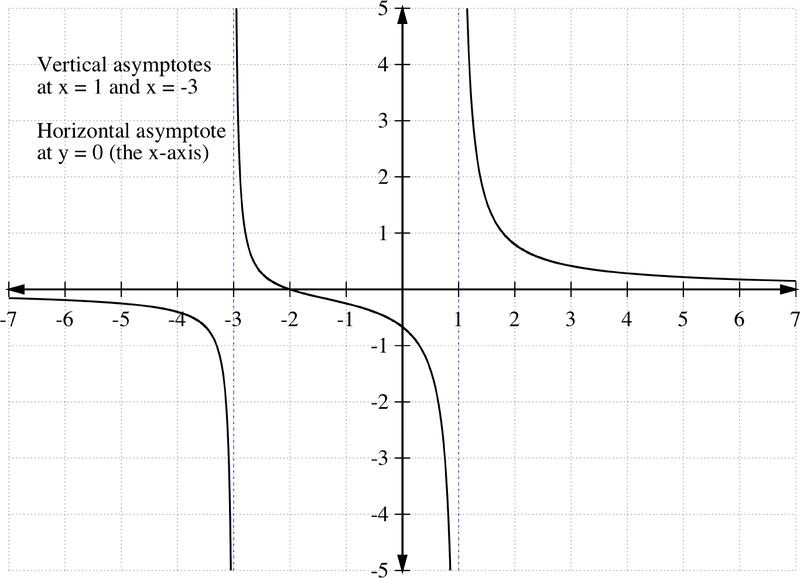

4
An asymptote is a line that a graph approaches but never touches (or only meets at infinity).
There are three main types:
1️⃣ Vertical Asymptote
Occurs when a function becomes undefined at a certain x-value (often due to division by zero).
2️⃣ Horizontal Asymptote
Describes the behavior of a function as x approaches positive or negative infinity.
3️⃣ Oblique (Slant) Asymptote
Appears when the degree of the numerator is exactly one higher than the denominator in a rational function.
Understanding these helps you:
- Sketch graphs accurately
- Prepare for exams
- Analyze limits
- Solve calculus problems
Function Types Supported in the Calculator
Our Asymptote Calculator supports four major function types:
- Rational Functions (P(x)/Q(x))
- Logarithmic Functions
- Exponential Functions
- Hyperbolas
Each type follows different asymptote rules.
How to Use the Asymptote Calculator
Using the calculator is simple and requires only a few steps.
Step 1: Select Function Type
Choose from:
- Rational
- Logarithmic
- Exponential
- Hyperbola
The calculator automatically updates input fields based on your selection.
Step 2: Enter Required Values
For Rational Functions:
- Numerator degree
- Numerator leading coefficient
- Denominator degree
- Denominator leading coefficient
- Vertical asymptote x-value
For Logarithmic Functions:
- Logarithm base
- Horizontal shift
For Exponential Functions:
- Exponential base
- Vertical shift
For Hyperbolas:
- a² value
- b² value
- Center (h, k)
Step 3: Click “Calculate”
The calculator instantly displays:
- Vertical asymptote(s)
- Horizontal asymptote
- Oblique asymptote
- Mathematical explanation
How Asymptotes Are Determined
Rational Functions
For a rational function:
f(x) = P(x) / Q(x)
The asymptotes depend on degrees of numerator and denominator.
Case 1: Numerator Degree < Denominator Degree
Horizontal asymptote:
y = 0
Case 2: Degrees Are Equal
Horizontal asymptote:
y = (leading coefficient ratio)
Case 3: Numerator Degree = Denominator Degree + 1
Oblique (slant) asymptote exists.
Case 4: Numerator Degree > Denominator Degree + 1
No horizontal asymptote.
Vertical asymptotes occur where the denominator equals zero.
Logarithmic Functions
A logarithmic function has:
- A vertical asymptote at the horizontal shift value.
- No horizontal asymptote.
Example:
f(x) = log(x − 2)
Vertical asymptote at:
x = 2
Exponential Functions
An exponential function has:
- A horizontal asymptote at the vertical shift value.
- No vertical asymptote.
Example:
f(x) = 2ˣ + 3
Horizontal asymptote:
y = 3
Hyperbolas
For hyperbolas in standard form:
(x − h)² / a² − (y − k)² / b² = 1
They have two oblique asymptotes:
y − k = ± (b/a)(x − h)
The calculator computes slopes automatically.
Example Calculations
Example 1: Rational Function
Numerator Degree: 2
Denominator Degree: 2
Leading Coefficients: 3 and 1
Since degrees are equal:
Horizontal asymptote:
y = 3
Example 2: Logarithmic Function
Base: 10
Shift: 4
Vertical asymptote:
x = 4
Example 3: Exponential Function
Base: 2
Vertical Shift: -5
Horizontal asymptote:
y = -5
Example 4: Hyperbola
a² = 4
b² = 9
Center = (0,0)
Slopes:
±(√9 / √4) = ±(3/2)
Oblique asymptotes:
y = ±1.5x
Why Use This Asymptote Calculator?
✔ Saves time
✔ Eliminates algebra mistakes
✔ Works for multiple function types
✔ Provides explanation text
✔ Perfect for homework & exams
✔ Beginner-friendly interface
Instead of memorizing every asymptote rule, you can verify results instantly.
Who Should Use This Tool?
This calculator is ideal for:
- Algebra students
- Pre-calculus learners
- Calculus students
- SAT / ACT test prep
- Teachers verifying examples
- Anyone studying function behavior
Common Mistakes Students Make
- Forgetting to compare degrees in rational functions
- Confusing vertical and horizontal asymptotes
- Ignoring shifts in log/exponential functions
- Miscalculating leading coefficient ratios
- Forgetting ± in hyperbola asymptotes
This calculator helps avoid those errors.
Frequently Asked Questions (FAQs)
1. What is a vertical asymptote?
A line x = a where the function becomes undefined.
2. What is a horizontal asymptote?
A line y = b that the function approaches at infinity.
3. When does a rational function have y = 0 as asymptote?
When numerator degree is less than denominator degree.
4. Do logarithmic functions have horizontal asymptotes?
No, they have vertical asymptotes.
5. Do exponential functions have vertical asymptotes?
No, only horizontal ones.
6. What is an oblique asymptote?
A slanted line the graph approaches.
7. When does a slant asymptote occur?
When numerator degree is exactly one higher than denominator.
8. Can a function have both vertical and horizontal asymptotes?
Yes, rational functions often do.
9. Does every hyperbola have asymptotes?
Yes, two oblique asymptotes.
10. What happens if degrees differ by more than one?
No horizontal asymptote exists.
11. Is this calculator accurate?
Yes, based on mathematical rules entered.
12. Can I use decimals?
Yes, decimal coefficients are supported.
13. Does this replace solving limits?
It simplifies asymptote identification, but understanding limits is still important.
14. Is this calculator free?
Yes, completely free.
15. Is it good for exam preparation?
Absolutely. It helps verify answers quickly.
Final Thoughts
The Asymptote Calculator is a powerful academic tool designed to simplify complex function analysis. Whether you're working with rational expressions, logarithms, exponentials, or hyperbolas, you can quickly identify vertical, horizontal, and oblique asymptotes with clear explanations.
Stop guessing and start calculating accurately.
Try the Asymptote Calculator today and master function behavior with confidence.