
Stair Calculator
Building safe and comfortable stairs requires precise measurements. Whether you’re a contractor, carpenter, DIY homeowner, or renovation specialist, calculating the correct number of risers, tread depth, stair angle, and stringer length is essential for safety and building code compliance.
Our Stair Calculator Tool simplifies complex stair math into instant, accurate results. Instead of manually calculating rise/run ratios or using complicated formulas, you can enter your project dimensions and receive a complete stair layout, material breakdown, and compliance check in seconds.
Why Accurate Stair Calculations Matter
Incorrect stair measurements can lead to:
- Uneven riser heights (major tripping hazard)
- Non-compliance with building codes
- Improper stair angle
- Structural instability
- Material waste
Building standards like the International Code Council guidelines define strict requirements for:
- Riser height limits
- Minimum tread depth
- Stair width
- Maximum stair angle
- 2R + T formula (comfort rule)
Our stair calculator automatically checks these requirements so you can build with confidence.
What This Stair Calculator Does
This tool calculates:
- Total number of risers
- Total number of treads
- Actual riser height
- Actual tread depth
- Total stair run length
- Stair angle (in degrees)
- Stringer length
- Number of stringers required
- Material count (treads & risers)
- Code compliance check
- Visual stair diagram
Everything updates instantly after entering your measurements.
How to Use the Stair Calculator (Step-by-Step)
Using the tool is simple and takes less than a minute.
1️⃣ Enter Total Rise
This is the vertical height from the lower floor to the upper floor (in inches).
Example: 108 inches (9 feet floor height)
2️⃣ Enter Total Run
The horizontal space available for the staircase.
Example: 120 inches
3️⃣ Enter Desired Riser Height
Typical residential riser height: 7”–7.75”
4️⃣ Enter Desired Tread Depth
Standard tread depth: 10” minimum
5️⃣ Select Stringer Type
- Closed stringer (risers required)
- Open stringer (no riser boards)
6️⃣ Enter Stair Width
Minimum code width: 36 inches
7️⃣ Click Calculate
The tool instantly provides complete stair layout results and compliance status.
Example Stair Calculation
Let’s say you enter:
- Total Rise: 108″
- Total Run: 120″
- Desired Riser Height: 7″
- Desired Tread Depth: 10″
- Stair Width: 40″
The Tool Calculates:
- Number of risers: 15
- Number of treads: 14
- Actual riser height: 7.2″
- Actual tread depth: 10″
- Stair angle: ~35°
- Stringer length: calculated using the Pythagorean theorem
- Stringers needed: 3 (based on 40″ width)
- Code compliance: Verified
This eliminates guesswork and ensures your staircase meets safety standards.
How the Stair Calculator Ensures Code Compliance
The calculator checks:
✅ Riser Height
Must be between 4″ and 7.75″
✅ Tread Depth
Minimum 10″
✅ Stair Width
Minimum 36″
✅ Stair Angle
Maximum 37°
✅ 2R + T Rule
The comfort formula:
2 × Riser Height + Tread Depth = 24–25 inches
This formula ensures natural walking rhythm and comfortable climbing.
If any measurement fails, the tool clearly marks it as Non-Compliant, helping you adjust before construction.
Understanding Key Stair Components
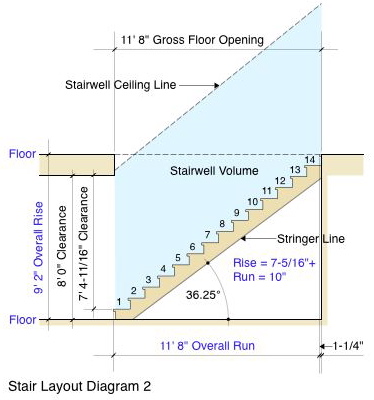
Stair Rise
The vertical distance from one floor level to another.
Stair Run
The horizontal depth of the staircase footprint.
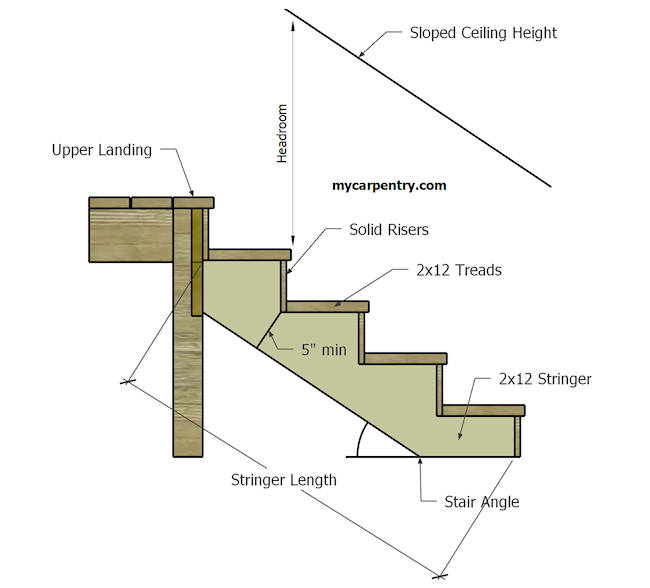
Riser
The vertical board between treads.
Tread
The horizontal surface you step on.
Stringer
The angled structural support that holds treads and risers.
Stair Angle
The slope of the staircase, affecting safety and comfort.
Stringer Calculation Explained
The tool calculates stringer length using:
√(Rise² + Run²)
This ensures you cut your structural lumber accurately without errors.
It also determines how many stringers are needed:
- Up to 36″ width → 2 stringers
- 36″–48″ width → 3 stringers
- Above 48″ → 4 stringers
This prevents sagging and structural weakness.
Stair Diagram Feature
The built-in stair diagram visually represents:
- Riser height
- Tread depth
- Step count
This helps contractors visualize proportions before cutting materials.
4
Who Should Use This Stair Calculator?
This tool is perfect for:
- Contractors
- Carpenters
- DIY homeowners
- Remodelers
- Deck builders
- Construction students
- Architects (for quick field estimates)
Whether you’re building deck stairs, basement stairs, porch steps, or interior residential stairs, this tool simplifies the process.
Benefits of Using Our Stair Calculator
✔ Instant results
✔ Accurate calculations
✔ Code compliance check
✔ Material estimation
✔ Visual diagram
✔ Beginner-friendly
✔ Mobile responsive
✔ Saves time & reduces waste
Pro Tips for Building Safe Stairs
- Always measure twice before cutting.
- Keep riser heights consistent.
- Use pressure-treated lumber for exterior stairs.
- Double-check local building codes.
- Ensure proper anchoring at top and bottom.
- Install handrails where required.
Frequently Asked Questions (FAQs)
1. What is the standard stair riser height?
Between 7″ and 7.75″ for residential stairs.
2. What is the minimum tread depth?
10 inches minimum.
3. How many stringers do I need?
2 for narrow stairs, 3–4 for wider stairs depending on width.
4. What is the 2R + T rule?
2 × riser height + tread depth must equal 24–25 inches.
5. What is the maximum stair angle?
37 degrees for residential compliance.
6. Why are risers important?
They provide structural support and prevent foot slip-through.
7. Can I build stairs without risers?
Yes, open stringer stairs don’t require riser boards.
8. How do I calculate stringer length?
Using the square root of rise² + run².
9. What happens if riser heights vary?
It creates a serious tripping hazard and fails inspection.
10. What stair width is required by code?
Minimum 36 inches.
11. Is this tool suitable for deck stairs?
Yes, it works perfectly for deck and porch stairs.
12. Does the calculator adjust tread depth automatically?
Yes, if total run space is limited.
13. Can beginners use this calculator?
Absolutely — it’s designed for simplicity.
14. Is this stair calculator free?
Yes, it’s completely free to use.
15. Does this tool replace professional inspection?
No. Always consult local building authorities for final approval.
Final Thoughts
Designing stairs doesn’t have to be complicated. With our powerful Stair Calculator Tool, you can instantly determine accurate riser heights, tread depth, stringer length, stair angle, and code compliance — all in one place.
Whether you’re building a deck, finishing a basement, or planning a renovation, this calculator ensures your staircase is safe, comfortable, and built to standard.
Save time. Reduce errors. Build safer stairs.